
It depends on what you found and where. On most British beaches a pebble or two is not against the law, but some stretches have formal bans. Fossils on the Dorset coast come under a collecting code, and anything from a ship must be reported within 28 days. Possible treasure in England and Wales has a shorter deadline still, at 14 days.
| You found | What applies | Who to tell | Deadline |
|---|---|---|---|
| Pebbles, sand, gravel | Allowed on many beaches unless an order or designation says otherwise | Nobody, but read the signs | None |
| Loose fossils, West Dorset | Local collecting code | Heritage centre, for key finds | See code |
| Part of a ship or its cargo | Wreck material | Receiver of Wreck | 28 days |
| Old gold, silver or coins | Possibly treasure | Finds Liaison Officer | 14 days |
Pebbles and sand
The belief that taking any pebble from any beach breaks the law is widespread, and is too simple. According to the British Geological Survey, section 18 of the Coast Protection Act 1949 lets a coast protection authority restrict the removal of materials such as sand, gravel or rocks from a particular stretch of coast. The authority has to make an order, and a minister has to confirm it. Where one is in force, removing material without a licence is unlawful. Where none has been made, the Act does not apply, and the BGS says this is the position on most UK beaches at present.
There are reasons for those orders. A shingle bank can be part of how a place is protected from the sea, as anyone reading our guide to coastal erosion will appreciate. Signs are usually posted where a ban is enforced, so read them on arrival. Ownership and conservation designations can also matter: the BGS names Sites of Special Scientific Interest and Marine Protected Areas as extra reasons to check first.


The BGS article's author describes a personal limit of six small pebbles per visit, leaving the rest for other people. That is one geologist's habit and not a legal allowance, but it is a sensible way to think about it. A bucket or a car boot is another matter altogether. We could not find a source we were happy with on shells specifically, so treat them the same way: read the local signs, and leave anything with a living creature in it.
Fossils
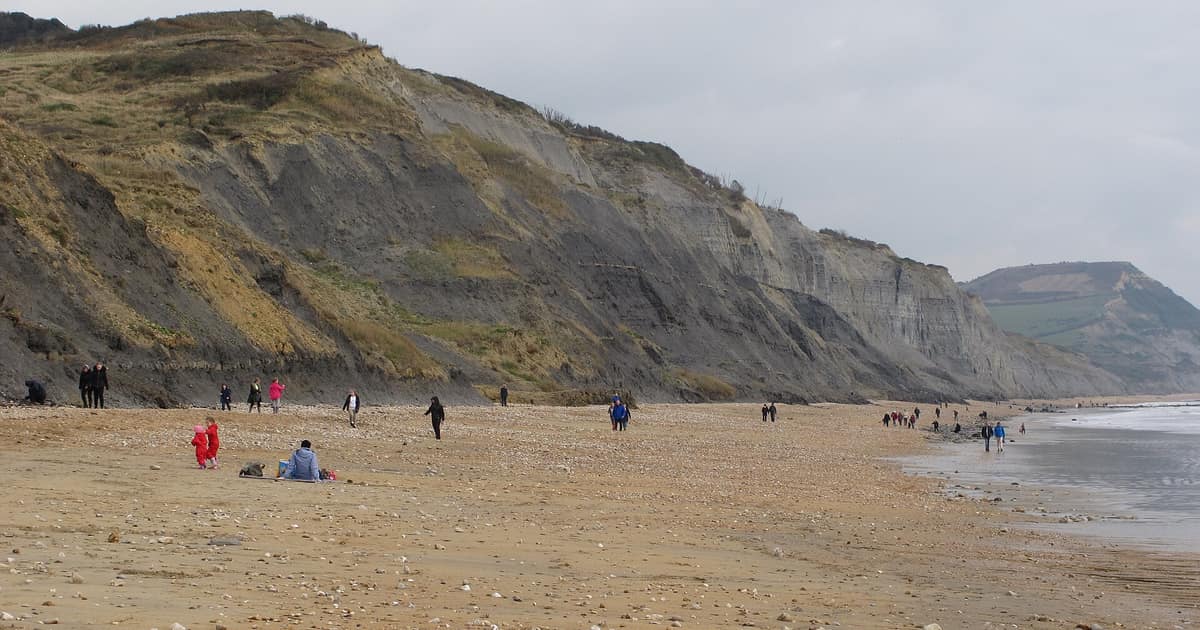
The rules here are set locally, and the best known example is around Charmouth and Lyme Regis. The Charmouth Heritage Coast Centre publishes the West Dorset code and a separate one for the Undercliffs National Nature Reserve. Their approach may surprise you: because the sea destroys what the cliffs release, responsible collecting is encouraged here. Collectors are asked not to dig into the cliffs without permission, and to record specimens of key scientific importance at the centre.
The code also sets out what happens to ownership. If collectors follow it, the fossils they find on National Trust, Charmouth Parish Council and certain Natural England land are transferred to them. Anyone wanting to sell an important specimen must first offer it to an accredited UK museum.
The centre's first tip is also the safest: look in the loose material on the beach, not in the cliffs. HM Coastguard warns that cliff falls and landslides happen without warning, and a fossil beach is still a tidal beach, so read a tide table before you start. Elsewhere in Britain the sensitivities differ. A site with finite fossil reserves may need much more restraint, so ask locally before you go.
Anything that came off a ship
This is the one to take seriously, because the law puts the duty on you. GOV.UK says that if you recover wreck material, meaning things found on the seashore or in tidal water that have come from a ship, aircraft or hovercraft, you must report it to the Receiver of Wreck within 28 days, or you could be fined £2,500. The fine is as stated on the page at the time of writing, so check for changes.
The categories are older than they look.
- Flotsam stayed afloat after a ship sank.
- Jetsam was thrown overboard from a ship in danger of sinking.
- Derelict is property abandoned at sea with no hope of recovery.
- Lagan was buoyed before being cast overboard, so that it could be recovered.
Boats that have come off their moorings, and marker or mooring buoys, do not normally count, unless a buoy is part of fishing equipment. If you are unsure, the Receiver of Wreck can tell you: GOV.UK gives the address [email protected]. Reporting gives the legal owner a chance to get the property back, and you may be entitled to a salvage award.
Old metal, coins and possible treasure
Things not from a vessel may count as treasure. Under the Treasure Act 1996, as summarised in HMRC's manual, that includes non-coin objects at least 300 years old with at least 10 per cent gold or silver by weight, and groups of old coins. In 2023 the government widened the definition to take in exceptional metal finds over 200 years old that give an important insight into the country's heritage.
In England and Wales, GOV.UK's step-by-step guide says to report treasure to your local Finds Liaison Officer within 14 days. Its wreck page describes the same 14-day duty as a report to the local coroner, so the officer is a good first call. Scotland and Northern Ireland have different rules for historic or valuable items, so use their own guidance there.
If you plan to go looking with a metal detector, get permission first. Countryfile's guide notes that the Crown Estate requires prior consent for detecting on its land, and much of the foreshore belongs to someone in particular, as our piece on who owns the beach explains. The same article passes on a curiosity worth knowing for the pub quiz: a whale or sturgeon washed up on an English beach belongs to the King.
Sources opened for this entry
- British Geological Survey: collecting beach pebbles
- Charmouth Heritage Coast Centre: the fossil collecting code
- GOV.UK: report wreck material
- GOV.UK: report treasure, wreck material or archaeological finds
- HMRC Capital Gains Manual CG77525: treasure
- GOV.UK press release: changes to the definition of treasure (2023)
Links last checked 8 November 2026. Rules, figures and timetables change, so follow the source for the current position.